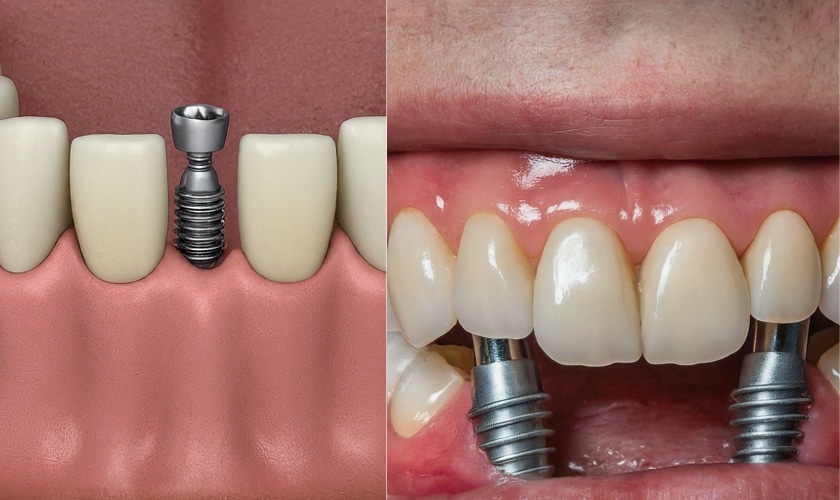
Dental implants are artificial tooth roots made of titanium or zirconia that a dentist places in the jawbone. They support replacement teeth such as crowns, bridges, or dentures, and they provide a stable foundation for these restorations. Since tooth-loss situations vary, dentists use different implant approaches to meet each patient’s needs. Here are some different types of dental implants:
Single Tooth Implant
A single tooth implant replaces one missing tooth. The dentist places a titanium post into the jawbone where the gap sits. After the area heals, an abutment connects to the post, and a custom crown attaches on top. This approach treats each gap independently, so neighboring teeth stay untouched. The process usually takes several months from placement to the final crown. Healing time depends on your bone density and general health, and your dentist will outline each stage during the planning appointment. Single dental implants suit people who have lost one tooth to decay, injury, or extraction.
Implant-Supported Bridge
When you lose several teeth in a row, an implant-supported bridge fills the space. Rather than placing an implant for every missing tooth, the dentist uses two or more implants to anchor a connected row of replacement teeth. The implants sit at each end of the gap, and the bridge spans the distance between them. This method reduces the number of implants needed for a wider gap. It also spreads chewing forces across the anchored posts.
An implant-supported bridge differs from a traditional bridge, which relies on grinding down adjacent natural teeth for support. Implants provide the foundation, and the surrounding healthy teeth remain intact. Your dentist will measure the gap and check your bone before recommending this option.
Full-Arch Implants
Full-arch implants replace an entire row of teeth on the upper jaw, the lower jaw, or both. Instead of one implant per tooth, this approach uses a set number of strategically placed implants to hold a full arch of fixed teeth. A common design places four implants per arch, but the exact number varies based on your anatomy.
The fixed arch stays in place and does not come out for cleaning at night. This differs from removable dentures, which sit on the gums and are removed daily. The dentist positions the implants at angles that use available bone, and this can reduce the need for extra grafting procedures.
Treatment steps often include a scan, surgical placement, a healing phase, and attaching the final prosthesis. Some clinics offer a temporary set of teeth on the same day as surgery, and the permanent arch is fitted later. People who have lost most or all of their teeth in one jaw may be a candidate for this treatment. Your dentist will review your bone volume and overall oral health to see whether it fits your situation.
Learn More About Dental Implants
Each type of dental implant addresses a specific pattern of tooth loss, from a single gap to a full arch. Single tooth implants treat isolated spaces, implant-supported bridges cover a row of missing teeth, and full-arch implants restore an entire jaw. The right choice depends on how many teeth are missing and the condition of your jawbone. To find the option that fits your needs, book a consultation with a dentist today.