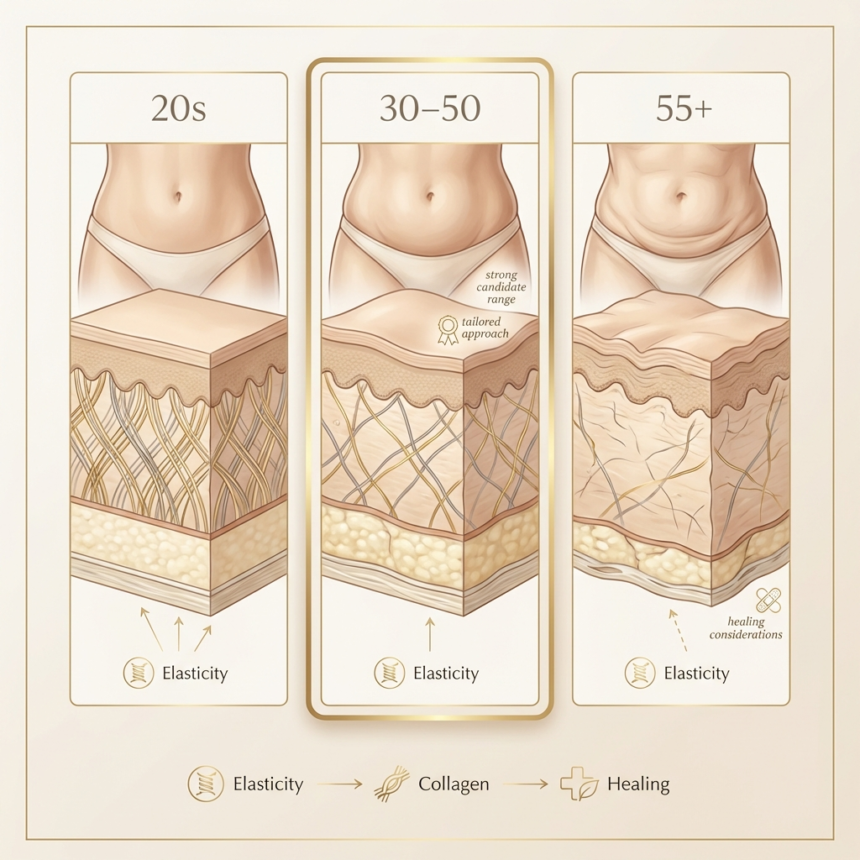
Choosing between a full and mini tummy tuck depends on your anatomy, goals, and how much correction you need. Both procedures address excess skin and weakened abdominal muscles, but they differ in scope, incision length, and recovery time. Because these differences affect both the process and the outcome, understanding them helps you have a more productive conversation with your surgeon. Here is more information on the differences between procedure types:
What Are Full Tummy Tucks?
A full tummy tuck addresses the entire abdominal region, from the pubic area to the upper abdomen near the ribcage. The surgeon makes a hip-to-hip incision along the lower abdomen; this incision may be positioned low enough to be hidden by underwear or swimwear. As the surgeon performs the procedure, excess skin is removed, the belly button is repositioned, and the rectus abdominis muscles are tightened using sutures. This muscle tightening corrects the separation that sometimes occurs after pregnancy.
Recovery generally takes a few weeks. Strenuous exercise and heavy lifting are typically restricted for four to six weeks, but the surgeon determines the exact timeline based on individual healing. Patients benefit from this option when they have significant skin laxity, muscle separation above and below the navel, or stretch marks extending across the full abdomen.
What Are Mini Tummy Tucks?
A mini tummy tuck focuses only on the lower abdomen, which is the area below the belly button. The incision is shorter than a full tummy tuck incision. The belly button may not be repositioned; the surgeon leaves it in its original location. This approach suits patients with localized skin laxity or mild muscle separation confined to the lower abdomen.
Recovery timelines are shorter as well; patients may resume light activities more quickly. Mild bruising and swelling are common. A smaller surgical area generally results in less postoperative discomfort. Candidates usually have good skin elasticity in the upper abdomen, and they have minimal muscle separation above the navel, which keeps the procedure limited to the lower region.
How Do They Differ?
The primary differences between a full and mini procedure come down to scope, incision size, and recovery.
- Treatment area: A full procedure treats the upper and lower abdomen and repositions the belly button. A mini procedure treats only the lower abdomen and leaves the belly button in its original position.
- Incision length: Full incisions extend from hip to hip. Mini incisions may be shorter and placed closer to the pubic hairline.
- Recovery time: Patients undergoing a full procedure face a longer healing period. Those receiving a mini procedure typically return to daily routines sooner.
How Are They Chosen?
Choosing between these two options starts with a physical evaluation. Surgeons assess skin elasticity, the location and extent of muscle separation, and the distribution of excess fat across the abdomen. Patients with minimal skin laxity above the navel may be good candidates for a mini procedure; those with more extensive skin laxity or muscle separation spanning the full abdomen typically benefit from a full tummy tuck. A history of significant weight loss also points to a full procedure, since it usually leaves more excess skin to correct.
Seek Professional Guidance
Selecting the right procedure requires a personalized assessment from a plastic surgeon. A thorough physical exam includes a discussion of your goals, and it helps determine whether a full or mini tummy tuck aligns with your needs. If you are evaluating your options, schedule a consultation with a plastic surgeon.