

Sports injuries affect muscles, tendons, ligaments, bones and other tissues that provide stability and enable movement. They can happen suddenly, or they can develop gradually from repetitive overload. When athletes fall, receive a blow or twist a joint, acute injuries can occur, while repeated stress can cause chronic injuries to the foot and ankle.
Recognizing Foot and Ankle Injuries
Foot and ankle sprains are common sports injuries. A sprain occurs when a person rolls, twists or turns an ankle awkwardly; the motion can stretch or tear the ligaments that stabilize the joint. When athletes land awkwardly while jumping or pivoting, the ankle can twist, and landing on another person’s foot or walking on an uneven surface can also cause a sprain.
Sprains vary in severity. A ligament can stretch minimally, or it can tear completely; the degree of injury affects treatment. Athletes who participate in sports with frequent pivoting, such as volleyball and basketball, face a higher risk of ankle sprains because those activities place repeated demands on the joint.
Identifying Overuse Foot Conditions
Achilles tendinitis usually results from overuse. It affects the Achilles tendon, which connects the calf muscle to the back of the heel; people with the condition usually feel pain and stiffness there, especially in the morning. Although Achilles tendinitis is usually chronic, serious cases can lead to a tendon tear that may require surgery.
Shin splints cause pain along the inner side of the lower leg. The condition involves inflammation where a muscle attaches along the inside length of the shinbone; it occurs primarily in runners, particularly those who are beginning a running program. Plantar fasciitis is another condition treated in care, while tendon disorders are also among the conditions addressed by orthopedic surgeons.
Understanding Bone and Joint Injuries
Stress fractures develop from repetitive stress rather than a single injury. They occur largely in weight-bearing bones of the lower extremity, including the foot bones, and running and jumping sports such as gymnastics, tennis, basketball, and track and field are associated with these injuries. Because running creates forces two to three times a person’s body weight on the lower limbs, repeated impact can place substantial stress on the bones.
Lisfranc injuries affect the midfoot. They are among the traumatic injuries treated by foot and ankle specialists; they differ from stress fractures because stress fractures develop through repetitive loading. Other injuries can affect the ankle as well, including fractures, Achilles tendon ruptures and tendon disorders.
Reviewing Treatment and Recovery Options
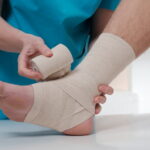
Treatment depends on the type of injury. Many sports injuries can be treated at home with rest, ice, compression and elevation, while severe injuries can require evaluation by a health care provider. When an injury needs additional care, treatment can include physical therapy, a cast, splint or brace, and in some cases require surgery.
Diagnosis begins with a history and physical examination. Foot and ankle specialists obtain radiographs during visits; they review MRI, CT scans, or bone scans when those studies are available. If additional support is needed, care can include braces, boots, over-the-counter casts, orthotics, or diagnostic and therapeutic injections with steroids, platelet-rich plasma, or other stem cell preparations.
Rehabilitation supports a return to activity. Exercise and other therapies are usually included before a person resumes the sport or activity that caused the injury; the rehabilitation approach depends on the injury and treatment received. When conservative treatment does not resolve an injury, surgery can be considered as another treatment option.
Schedule an Evaluation
Orthopedic surgeons diagnose and treat disorders involving the bones, joints, ligaments, muscles, tendons and nerves of that area. Their training includes four years of medical school, five years of orthopedic surgery residency, and one additional year of advanced fellowship training; this specialized education prepares them to treat a broad range of foot and ankle conditions. Consult an orthopedic surgeon before beginning foot or ankle treatment, particularly when surgery is advised.